The story behind Checkmate Assistant
From self check-in to Checkmate Assistant
How the aim of letting hotel guests check themselves in grew from a chat prototype into Checkmate Assistant in two years: one platform for the complete guest journey and hotel operation.Checkmate Assistant did not start with an elaborate product plan or a list of dozens of features.
Tim Schalke and I have known each other since we were about twelve. These days, as a hospitality manager, he runs hotels together with his business partner Benjamin Koch, including Hotel de Duif, Hotel Lowietje, Boutique Suites Lisse and Hotel van Saaze, along with a number of hotels in Belgium.
At one of those hotels, he wanted guests to be able to check themselves in because staff shortages meant the front desk could not always be staffed. His question to me: could I build something for that?
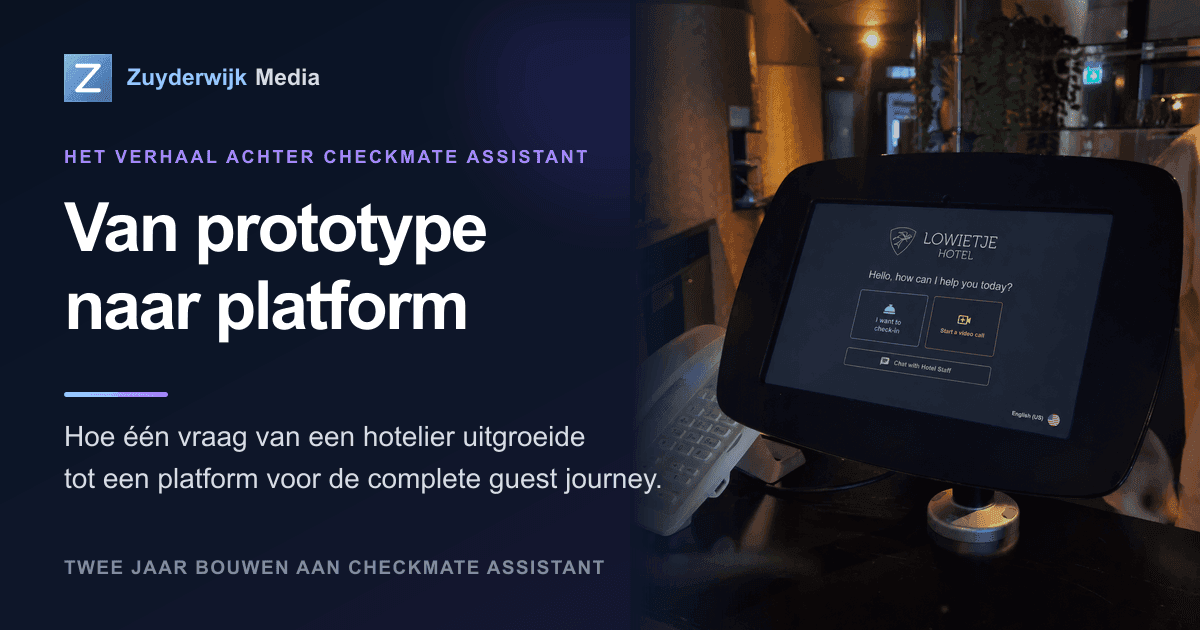
Those are the kinds of questions I enjoy. There is a clear problem behind them, but no prescribed solution yet. So I started with a prototype: a chat assistant that could guide a guest through the check-in process.
That worked as a starting point. More importantly, it revealed just how much happens around a seemingly simple check-in.
From chat to personal contact at a distance
Self-service is useful, but hospitality should not disappear when no member of staff is standing behind a desk.
That is why remote video calling was added to the prototype quite early. If guests could not complete the process themselves, they needed to reach someone who understood the situation and location immediately, without searching for a general phone number or explaining everything again.
The first interface ran on an iPad. That soon proved too limited as a product direction. Hotels did not want to manage one fixed screen; they wanted to offer several touchpoints: mobile, tablet, kiosk and, later, each guest's personal portal.
The iPad interface grew into a centrally managed device environment, with per-hotel settings, visibility into device and flow status, and a complete management system behind it.
From that point on, we were no longer building only a digital front desk. We were building the operational layer around it.
The door turned out to be the end of a much longer chain
A guest checking in independently ultimately wants to reach the room without friction. Before access can be issued, however, a great deal has to be correct behind the scenes.
The reservation must be known. Guest and fellow-traveller details must be complete. Depending on the hotel, identity, payment, deposit, terms and arrival time may need to be checked. Only then can the correct access system release the correct door for the correct guest and period.
Hotels rightly use several specialised systems for this. A PMS such as Mews or LodgeGate serves a different purpose from a payment provider or an access solution such as Hotek Hospitality Group, Vingcard, part of ASSA ABLOY Group or Intratone.
Guests should not have to see that software landscape. To them, it is one stay.
Checkmate Assistant therefore became the connecting layer between existing hotel systems, the hotel team and the guest. Reservation, pre-arrival, registration, payment, check-in and access were no longer separate screens, but parts of the same status-driven journey.
Not just check-in, but the complete guest journey
As we built, it became increasingly clear that the need does not end when the room door opens.
Before arrival, a hotel wants to send the right information automatically, collect missing details and offer relevant extras. On arrival, guests want to check in on mobile or at a kiosk. Questions and requests arise throughout the stay. At departure, checkout, feedback and follow-up belong to that same guest context.
- BookingThe reservation arrives and the personal journey begins.
- Pre-arrivalDetails, preferences and arrival are arranged in advance.
- PaymentOutstanding amounts can be settled before arrival.
- Check-inThe guest completes the required steps independently.
- AccessThe right key is released once everything is in order.
- Stay & departureService and support remain close through departure.
- Guest portal
- Kiosk
- Phone
Checkmate now supports much more than self check-in:
- Pre-arrival communication and mobile check-in without a mandatory app download
- A personal guest portal for the stay, access and service
- Conversations through channels including WhatsApp, website chat, guest portal, kiosk and phone
- AI-assisted answers based on the hotel's information and operating procedures
- Transfer to a team member whenever personal contact is required
- Guest requests for housekeeping, maintenance, room service, late checkout or transport
- Payments, deposits and relevant upsells within the guest journey
- Digital key delivery and access control once the required conditions have been met
- Housekeeping with room statuses, tasks, checklists and maintenance follow-up
- Feedback, operational reporting and insight into recurring questions and bottlenecks
The chat assistant that started it all therefore still exists at the heart of the product. It is simply no longer disconnected from operations. A request for extra towels can become a housekeeping task. A late-checkout question can enter a controlled request and payment flow. A phone conversation can be transferred to a team member with the relevant context available.
To me, that is the interesting difference between a chatbot and a hospitality platform.
The nerdy part: building states, not screens
The front-end experience should remain calm. Behind the scenes, that same journey consists of events, states and exceptions.
Has the reservation been found? Are all mandatory steps complete? Did the payment succeed? May access already be issued? Has a request been assigned? Does a conversation need human attention? And what happens when an external system is temporarily unavailable?
At that point, you are not merely building pages. You are building orchestration.
Actions need to be retried safely without duplicate payments, duplicate tasks or access being issued twice. Hotel staff need to see where a process is waiting. Permissions, audit trails and data flows must be correct for each hotel and role. Devices and critical flows must remain centrally manageable and observable.
These are the less visible parts that allow a prototype to become a serious, enterprise-grade platform.
Two years later
What started with the aim of letting guests check themselves in despite a front-desk staff shortage has, two years later, grown into Checkmate Assistant: a hospitality management platform that supports the guest journey from the moment a booking arrives through checkout, feedback and the operations surrounding it.
Not because we knew the final destination on day one, but because every prototype exposed the next problem.
First chat. Then video calling. Next, a managed interface for different devices. Then the management system, integration layer, guest messaging, requests, access, housekeeping, AI through chat and phone, and the reporting a hotel team needs to stay in control.
That is also why I enjoy working on products like this. Throw a difficult problem my way and I usually only get more enthusiastic.
Checkmate Assistant is now in its soft-launch phase. That does not mean the product is suddenly finished. In my view, serious software never really is. But the foundation is ready and we are entering the market with something that brings together two years of thinking, prototyping, testing and rebuilding.